Crown thinning in Forest Gate
If you are looking for crown thinning in Forest Gate, you are probably trying to solve a very practical problem: a tree that has become too dense, too heavy, too shaded, or simply difficult to manage in a busy garden or commercial space. Crown thinning is a careful pruning method that removes selected branches throughout the canopy to let more light and air pass through, while keeping the tree’s natural shape intact. It is a popular choice for local homes, landlords, schools, estates, and businesses in and around Forest Gate because it improves tree health, reduces wind resistance, and helps trees sit more comfortably within their surroundings.
Unlike heavy reduction work, crown thinning is designed to be subtle. The aim is not to make a tree look hacked back, but to refine the canopy in a way that supports the tree and the property around it. In a place like Forest Gate, where gardens can be compact, access can be tight, and trees often grow close to fences, paths, roofs, and neighbouring properties, this type of service needs to be carried out with care, judgement, and the right equipment. A local team that understands these conditions can make a noticeable difference to comfort, safety, and overall appearance.
Whether you are dealing with a mature maple that is shading the rear rooms, a conifer that feels too dense near the boundary, or a street-facing tree that is blocking natural light, crown thinning may be the right solution. Below, you will find a detailed look at what the service involves, when it is useful, what customers in Forest Gate typically ask for, and how to prepare if you are planning to book a visit or request a quote.
What crown thinning means for Forest Gate properties

Crown thinning is the selective removal of smaller branches from within the tree’s canopy. The process reduces density without changing the overall height or outline of the tree too much. For many property owners, this makes it an ideal middle ground between doing nothing and carrying out more dramatic pruning. It is especially useful where the tree is healthy but has simply become too full, too wind-sensitive, or too dominant in the space around it.
In Forest Gate, trees are often part of mixed residential streets, front gardens, rear terraces, shared access ways, and commercial plots where every metre of space matters. Dense crowns can create persistent shade, trap moisture, obstruct views, and make outdoor spaces feel closed in. By thinning the canopy in a controlled way, you can often improve light levels and airflow while keeping the tree attractive and structurally balanced.
Local tree care matters because the right pruning approach depends on the species, size, location, condition, and surroundings of the tree. A skilled arborist will not simply remove random branches. They will assess how the tree responds to weight distribution, where rubbing or crowded stems are forming, and how much thinning is appropriate for the specific situation. That judgement is especially important in built-up areas where over-pruning can leave a tree exposed or weaken it unnecessarily.
Why customers ask for crown thinning in Forest Gate

There are many reasons people request crown thinning in Forest Gate, and most are tied to day-to-day comfort as much as to tree appearance. Some residents want more sunlight into kitchens, extensions, patios, or small lawns. Others are concerned about branches catching the wind or brushing against roofs and windows. Commercial customers may need trees to remain presentable without interfering with signage, parking spaces, loading areas, or safe pedestrian movement.
Another common reason is that a tree has simply matured into a fuller shape than the site can comfortably support. This is often the case in older gardens where trees were planted years ago and have now outgrown the original layout. In these situations, crown thinning can help a tree remain part of the landscape without overwhelming it. It can also reduce the sense of pressure that dense canopies create in enclosed spaces.
It is worth noting that crown thinning is not the right solution for every tree. A good local service will explain whether the issue is excessive density, poor form, deadwood, rubbing branches, wind loading, or another matter entirely. If the tree needs different work, such as selective lifting, deadwood removal, or a modest reduction, that should be discussed clearly before any pruning begins. This honest approach helps Forest Gate customers choose the most suitable service rather than a one-size-fits-all option.
Signs a tree may benefit from thinning
Many customers are unsure whether the tree in question actually needs crown thinning. Some signs are easy to spot, while others become more obvious over time. If your tree is casting a deep and lasting shadow, holding onto too much wind, or looking thick and congested in the upper branches, thinning may be worth considering.
Common signs include:
- Reduced daylight in nearby rooms or garden areas
- Branch crowding that makes the canopy look overly compact
- Rubbing or crossing branches within the crown
- Leaves and small twigs forming a dense screen
- More movement or strain in windy conditions
- Branches creating frequent contact with structures or adjoining trees
- A tree that looks healthy but simply too heavy or full
For many Forest Gate households, the trigger is practical rather than dramatic. You may not have a failing tree or a dangerous limb, but you may still want a better balance between tree cover and usable space. In those cases, crown thinning can provide a very noticeable improvement without changing the character of the tree more than necessary.
How crown thinning is carried out
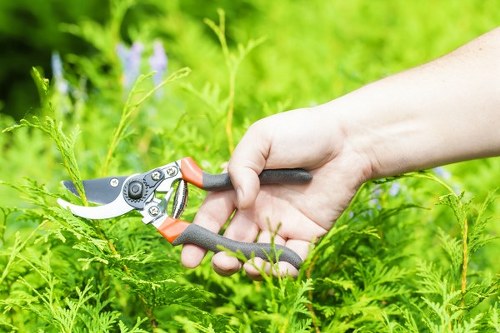
A proper crown thinning job begins with an assessment of the tree and its surroundings. The arborist will look at the species, age, health, branch structure, nearby buildings, access routes, and any visible constraints such as overhead lines, fences, sheds, greenhouses, parked vehicles, or shared boundaries. In Forest Gate, where access can range from open front drives to narrow rear gardens, this planning stage is essential.
The pruning itself usually involves removing selected secondary and tertiary branches across the canopy, not just cutting from one side. The goal is to distribute the thinning evenly so that the tree remains stable and natural in shape. A competent team will avoid leaving large gaps or “lion-tailing” the crown, which can place unnecessary stress on the remaining branch ends. Instead, they focus on improving light penetration and air movement in a measured way.
Because every tree responds differently, the work may be adjusted as the pruning progresses. Some crowns need only light thinning, while others may need a more considered approach to address congestion, poor branch spacing, or historical overgrowth. The best outcome is usually one that feels almost effortless from the outside: the tree simply looks healthier, lighter, and better suited to its environment.
What a local service can include
When customers enquire about crown thinning in Forest Gate, they often want to know exactly what is included. While each job is different, a well-organised service commonly covers several important stages from start to finish.
Typical inclusions may be:
- Initial inspection of the tree and surrounding access
- Discussion of the desired outcome and practical limitations
- Selective thinning of the crown to reduce density
- Removal of dead, damaged, or crowded branches where appropriate
- Careful shaping to preserve the tree’s natural form
- Clearing and tidying the work area after the job is complete
- Advice on future maintenance, if needed
Some customers also ask whether the service includes waste removal and site cleanup. That should always be clarified in advance, because the exact scope can vary. A straightforward quote process helps avoid confusion and makes it easier to compare options. If you are arranging tree work for a home, rental property, managed site, or commercial premises, knowing what is included can save time later and help you plan around the visit.
Why crown thinning suits local homes and businesses
Forest Gate has a mix of property types, and crown thinning is valuable because it adapts well to different settings. In family gardens, it can make seating areas brighter and easier to use. In side returns and narrow plots, it can reduce the overpowering effect of a dense canopy. For landlords and managing agents, it can help keep outdoor spaces more presentable and manageable between larger maintenance visits.
Commercial customers also benefit from the practical side of the service. Trees near retail units, offices, small industrial yards, schools, churches, and shared car parks may need to remain visually appealing while also supporting visibility, airflow, and safe movement. Dense trees can create litter build-up, dampness, and blocked sightlines. Thinning can ease those issues while keeping the site attractive and established.
Another major benefit is comfort. A tree that is too thick can make an otherwise pleasant outdoor area feel dark and enclosed. By allowing more filtered light through the canopy, crown thinning can improve the usability of patios, lawns, courtyards, and communal spaces. This is one of the reasons people often choose it over more severe pruning methods. It is a balanced, practical solution for places where the tree is welcome, but its current size or density is creating friction.
Local access, parking, and site considerations
One of the biggest advantages of using a local tree care company in Forest Gate is familiarity with real-world access issues. Many properties in the area have limited off-street parking, narrow entrances, shared drives, rear garden access through the house, or small working spaces near boundary lines. These details matter because they affect how quickly a team can set up, where equipment can be safely placed, and how waste is moved away from the site.
Local knowledge also helps when dealing with nearby roads, footpaths, neighbours, or commercial operations that need to keep running during the visit. A careful team will plan the job around these constraints and work in a way that keeps disruption reasonable. For example, they may choose different access methods for a back garden than for a front-facing tree, or they may adjust the timing of the work to fit around customer activity on a business site.
This practical experience is one reason many Forest Gate customers prefer a nearby arborist rather than a distant contractor who is less familiar with the area. The aim is not only to complete the pruning well, but also to do it smoothly, with respect for the property and the people using it.
How to prepare for a crown thinning visit
A little preparation can make the service run more smoothly and help the team work efficiently. You do not need to do anything complicated, but a few small steps can reduce delays and avoid unnecessary obstacles.
Helpful preparation steps include:
- Clear access to gates, side passages, or driveways if possible.
- Move cars, bins, garden furniture, or portable items away from the working area.
- Keep pets and children safely away from the tree work zone.
- Let neighbours know if branches overhang a shared boundary and access may be needed.
- Point out any specific concerns, such as weak limbs, roof contact, or restricted entry points.
- Check whether there are any site rules or timing restrictions for the property.
Even if your access is awkward, that does not necessarily mean the job is difficult. Many tree care teams work around tight spaces every day. What helps most is clear communication before the visit so that the team can plan the right equipment and approach. If there are particular concerns about surfaces, parking, or neighbouring gardens, these are best mentioned early.
For the best outcome, think about what you want the tree to achieve after the work is done. Do you want more light, less wind resistance, a better view, or a cleaner shape? Clear priorities make it easier for the arborist to suggest the most suitable level of thinning.
What affects the cost of crown thinning in Forest Gate
Customers often want an idea of pricing before they commit to any tree work, and that is entirely understandable. While exact prices are not possible without seeing the site, there are several common factors that influence the quote. Knowing these in advance helps you understand why two trees that look similar may still require different levels of work.
Typical pricing factors include:
- Tree size and height – larger trees usually take more time and equipment
- Canopy density – very full crowns may need more careful selective work
- Access – difficult entry, limited parking, or rear-garden-only access can affect the job
- Location around the property – trees close to buildings, fences, or utilities may need extra care
- Waste volume – more material usually means more time handling and removing branches
- Additional tasks – deadwood removal, clearance, or other related work may be discussed separately
For Forest Gate residents and business owners, the best approach is often to request a tailored quote after a site assessment. That way, the service can be matched to the actual tree and the practical conditions on the ground. It is also the most reliable way to avoid under-specifying the work, which can sometimes lead to a result that does not fully solve the original problem.
Why choose a local company for crown thinning?
A local company brings more than just convenience. It brings awareness of the kinds of properties, access challenges, and tree issues that are common in the area. That can make a real difference when a job needs to be planned around tight boundaries, mixed residential and commercial streets, or trees that have grown for decades in constrained urban settings.
There is also value in easier communication and more responsive scheduling. If you need advice about whether a tree should be thinned, lifted, or left alone for now, a local arborist can usually assess the situation with a practical eye. That kind of feedback is helpful when you are trying to make a sensible decision for your property rather than taking a guess.
Another advantage is consistency. A nearby team is more likely to understand common local tree species, how they behave in suburban gardens, and the kind of finish that suits homes and business sites in Forest Gate. That local understanding can improve both the process and the result.
Residential crown thinning: common situations
Homeowners usually request crown thinning for one of three reasons: to improve light, to reduce crowding, or to make the garden feel more open. In practice, it often solves a combination of all three. A mature tree can become a much better fit for a home once its canopy has been carefully opened up.
Some of the most common residential situations include:
- Trees shading rear living rooms, kitchens, or conservatories
- Overgrown garden trees near patios or seating areas
- Dense boundary trees affecting privacy but also blocking too much light
- Trees becoming awkward near sheds, garages, or extensions
- Canopies creating heavy leaf fall or dampness in sheltered corners
For many local homeowners, the appeal of crown thinning is that it preserves the feel of the tree. If you have spent years enjoying its presence, you may not want it removed or drastically altered. Thinning gives you a way to keep the tree while easing the problems it causes. That makes it a popular option for gardens where mature trees contribute to the look and value of the property.
Commercial and managed-site crown thinning
Commercial and managed properties in Forest Gate often need a more structured approach. Trees on business premises, communal grounds, rental properties, and shared sites should not only look tidy but also support day-to-day use of the space. Dense crowns can interfere with lighting, signage, vehicle movement, and general site presentation. They may also lead to complaints if branches are hanging low or shade is excessive in work areas or shared outdoor spaces.
On these sites, crown thinning can be part of a broader maintenance plan. The work may be scheduled to minimise disruption, with consideration for opening hours, deliveries, tenants, staff, or visitors. A good service will be mindful of the site’s operating needs while carrying out the pruning safely and efficiently. That flexibility is often a major benefit for local organisations that need dependable maintenance rather than one-off fixes.
For property managers, the key is often to keep trees looking established without letting them interfere with the function of the site. Crown thinning is well suited to that goal because it softens density without making the landscape look bare or overworked.
Frequently asked questions
Q: Will crown thinning damage my tree?
A: When carried out correctly, crown thinning is a controlled pruning method intended to support the tree rather than harm it. The amount removed should be appropriate for the species and condition of the tree.
Q: How much of the canopy can be thinned?
A: That depends on the tree, its health, and the reason for the work. A good arborist will recommend a level that improves light and airflow without making the crown too sparse or stressed.
Q: Is crown thinning the same as crown reduction?
A: No. Crown thinning reduces internal density, while crown reduction reduces the overall size of the canopy. They solve different problems and are sometimes used separately or together, depending on the tree.
Q: Can crown thinning help in windy areas?
A: Yes, in some cases. By reducing density, the canopy can offer less resistance to wind. However, the tree still needs to be assessed properly, especially if it is large or growing in an exposed position.
Q: Do I need permission before the work starts?
A: Some trees may be protected by local controls or other restrictions. If that might apply, it should be checked before any work is scheduled. A responsible tree care provider will raise this during the enquiry stage.
Q: How often should a tree be thinned?
A: There is no fixed timetable. Some trees only need attention occasionally, while others benefit from periodic maintenance. The right interval depends on the species, growth rate, and site conditions.
What to look for when choosing a service
When choosing a company for crown thinning in Forest Gate, look for clear communication, practical experience, and a sensible explanation of what the work will achieve. The best service providers will talk through the tree’s condition, the likely result, and any limitations before the job begins. That helps you feel confident that the work is based on the tree’s needs, not just on a quick visual estimate.
It is also worth choosing a team that values neatness and respect for the property. Tree work can create a fair amount of debris, especially when working on mature crowns. A tidy finish, good site management, and careful handling of waste are all signs that the service is organised and customer-focused. For local residents, that matters just as much as the pruning itself.
If you are comparing options, ask yourself whether the service sounds tailored or generic. Crown thinning should never feel routine in the wrong sense. Each tree, site, and customer need is different, and the right local team should be able to explain how they will adapt the work to suit your property.
Areas covered around Forest Gate
A local tree care team serving Forest Gate will often work across the surrounding neighbourhoods and nearby parts of the wider area, especially where similar housing layouts and access conditions are common. That may include streets with terraced homes, semi-detached properties, newer developments, mixed-use roads, and commercial premises with shared boundaries or limited service access.
Customers often appreciate being able to arrange work for adjoining areas as well, especially where a tree affects more than one property or where management is shared. This can be helpful for boundary trees, overhanging branches, or larger sites with multiple occupants. If you are not sure whether your location is covered, it is usually best to enquire and explain the access details rather than assume the job is too far away or too awkward to be worth discussing.
In practical terms, being local means the team can often respond more efficiently, understand the site conditions more quickly, and plan a visit with fewer surprises. That matters when you want the work done properly and without unnecessary delay.
Book crown thinning in Forest Gate with confidence
If a tree in your garden, shared space, or business premises has become too dense, too shady, or too dominant, crown thinning may be the solution you have been looking for. It is a smart way to improve light, airflow, and overall manageability while keeping the tree’s character intact. For many Forest Gate customers, that balance is exactly what they need.
Whether you are a homeowner wanting more usable daylight, a landlord maintaining a tidy boundary, or a business owner trying to keep a site practical and presentable, a local tree care service can help you decide on the right approach. The most effective next step is usually a site assessment and a clear discussion of the work you want carried out.
Contact us today to discuss your tree, request a free quote, or arrange a visit. If you are ready to improve the balance of your outdoor space, book your service now and take the first step toward a healthier, lighter, and more manageable canopy.
Choose a local team that understands Forest Gate properties, access challenges, and the practical needs of nearby homes and businesses.